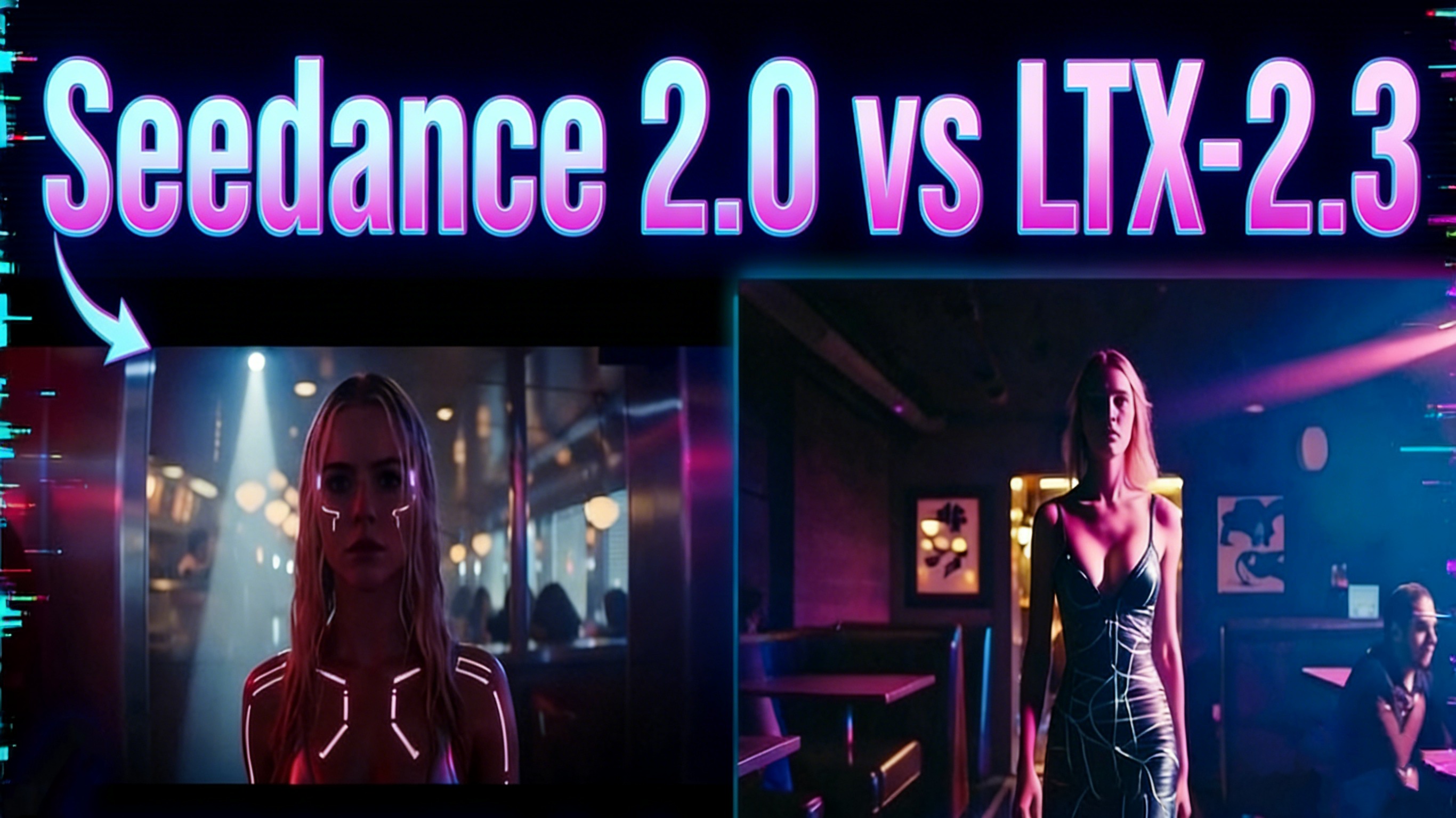
Seedance 2.0 is rapidly becoming the go-to AI video model for creators who want cinematic control, consistent motion, and native audio-visual generation. In this guide, we’ll break down Seedance 2.0 vs LTX-2.3 across real production scenarios — covering cinematic control, audio sync, motion consistency, deployment options, and output quality — so you can clearly understand which model fits your workflow.
What Is Seedance 2.0?
Seedance 2.0 is a next-generation AI video generation model designed for structured, production-ready workflows. Unlike earlier tools that focused on short experimental clips, Seedance 2.0 delivers cinematic motion, precise camera language, and native audio-video synchronization in a unified system.
At its core, Seedance 2.0 is built to interpret complex prompts — including scene structure, camera movement, and emotional tone — allowing creators to direct scenes rather than just generate them. The model runs on a dual-branch diffusion transformer architecture that processes video and audio latents in a single pass, ensuring audio events and visual events stay locked in sync at the millisecond level.
Key Capabilities of Seedance 2.0
Native audio-visual generation — dialogue, lip sync, ambient sound, and motion generated together in one pass
Strong temporal consistency — character identity, lighting, and environmental coherence maintained across frames
Director-level camera control — dolly, pan, zoom, rack focus, POV, tracking shots all responsive to natural language prompts
Multi-modal inputs — accepts text, reference images (up to 9), video clips (up to 3), and audio tracks (up to 3) simultaneously
@ Reference System — tag and bind specific characters, scenes, or audio themes directly in your prompt for cross-shot consistency
Multi-shot storytelling — built-in narrative planner that breaks prompts into shot sequences before generation begins
Production-ready outputs — 1080p and 2K resolution, up to 15 seconds, exportable in multiple formats
What Is LTX-2.3?
LTX-2.3, developed by Lightricks, represents a different philosophy in AI video. Released in March 2026 with 22 billion parameters, it scales significantly beyond its predecessor and is fully open-source under Apache 2.0 — the only model in this comparison that creators can run entirely on their own hardware.
One of the defining characteristics in the Seedance 2.0 vs LTX-2.3 comparison is that LTX-2.3 can run on consumer GPUs (with quantized variants requiring as little as 8GB VRAM), enabling private, offline, and fully customizable workflows.
Key Capabilities of LTX-2.3
22B parameter scale — stronger prompt adherence, better temporal coherence, and improved facial detail
Rebuilt VAE — fabric textures, chrome highlights, and fine details (hair, eyelashes) stay stable during motion
4x larger text encoder — complex multi-subject prompts and spatial instructions resolve accurately across the full clip
Native portrait mode — generates vertical 9:16 video directly, not cropped from landscape masters
Native audio + video generation — HiFi-GAN vocoder delivers clean one-pass audio
Local + cloud deployment — runs via ComfyUI, LTX Desktop App (Windows), or API on macOS
Open-source flexibility — Apache 2.0 license allows custom pipelines, LoRA training, and full infrastructure control
Seedance 2.0 vs LTX-2.3: Core Differences
When comparing Seedance 2.0 vs LTX-2.3, the key differences come down to creative control, workflow philosophy, and output style. Here is how they stack up across the dimensions that matter most in real creative workflows.
1. Cinematic Control vs Accessibility
Seedance 2.0 is built for directors.
It understands camera language at a semantic level — prompts like “slow dolly-in with shallow depth of field as the character turns” produce precise, predictable results. This makes Seedance 2.0 ideal for storytelling, commercials, and narrative content where specific camera intent needs to be honored.
LTX-2.3, on the other hand, is built for flexibility.
While it handles standard camera movements reliably and framing stays stable, it reaches its ceiling faster on complex compound moves, deliberate rack focus, or precise parallax effects. Its defining advantage is that the entire generation pipeline lives on your hardware.
In the Seedance 2.0 vs LTX-2.3 debate, this is the first major split: direction vs deployment.
2. Native Audio-Visual Generation
Both models support audio and video generation in a single pass — but the architecture differs.
Seedance 2.0 uses a unified multimodal dual-branch system that generates speech, lip sync, ambient sound, and motion together. This leads to more natural timing, stronger emotional expression, and fewer mismatches between sound and movement.
LTX-2.3 also generates audio natively via its HiFi-GAN vocoder, and audio-conditioned generations are more stable in this version than in LTX-2. However, for professional-level dialogue clarity and music richness, Seedance 2.0 sets the higher bar.
3. Motion Consistency and Physics
Seedance 2.0 excels at temporal consistency.
Scenes maintain stable motion, character identity, and environmental coherence across frames — even in high-action sequences involving vehicle motion, falling debris, or fight choreography. Characters move with physical believability throughout.
LTX-2.3 made meaningful gains with its rebuilt VAE: fabric weave, chrome reflections, and gradient transitions are all more stable than in LTX-2. It performs very well in controlled compositions and product-focused content. In complex multi-subject dynamic scenes, however, Seedance 2.0 maintains a visible edge.
4. Multi-Shot Storytelling
This is one of the sharpest distinctions in the Seedance 2.0 vs LTX-2.3 comparison.
Seedance 2.0 includes a built-in narrative planner that reads your prompt, breaks it into distinct shot sequences, and maintains character and scene consistency across every cut — within a single generation. The output can feel like a professionally edited sequence rather than a raw clip.
LTX-2.3 does not include an equivalent system. Creators can sequence clips manually in the LTX Desktop App timeline, but multi-shot narrative coherence within a single generation pass is not a built-in capability.
5. Workflow: Cloud vs Local
This is the biggest philosophical difference in Seedance 2.0 vs LTX-2.3.
Seedance 2.0 → optimized for cloud-based creative workflows with credit-based access on platforms like XMK — no local hardware required
LTX-2.3 → optimized for local execution with full control over hardware, data, and infrastructure
If you prioritize ease of use, fast iteration, and production-ready output without technical overhead, Seedance 2.0 is the better choice.
If you need full control over your hardware and data — or want to fine-tune and deploy on your own infrastructure — LTX-2.3 becomes highly attractive.
6. Portrait and Vertical Video
LTX-2.3’s native portrait mode is a genuine, practical advantage for social media creators. Vertical 9:16 compositions are generated directly from the model — not cropped from landscape masters — which produces cleaner edge discipline and framing for TikTok, Instagram Reels, and YouTube Shorts.
Seedance 2.0 supports multiple aspect ratios including 9:16, and its multi-shot storytelling system works across both orientations. For pure vertical-native generation, LTX-2.3 has a structural advantage.
Seedance 2.0 vs LTX-2.3: Feature Comparison Table
Feature | Seedance 2.0 | LTX-2.3 |
|---|---|---|
Audio-Video Sync | Native, highly accurate | Native, good stability |
Cinematic Camera Control | Advanced — director-level | Moderate — standard moves |
Multi-Shot Storytelling | Built-in narrative planner | Manual sequencing required |
Motion Consistency | Very strong | Good, improved in 2.3 |
Reference System | @ tagging across assets | Character consistency improved |
Portrait Mode | Supported | Native 9:16 optimized |
Deployment | Cloud-based | Local + cloud hybrid |
Open Source | No | Yes (Apache 2.0) |
Ease of Use | High | Medium |
Parameter Scale | Proprietary | 22B (open) |
Resolution | 1080p / 2K | Up to 4K |
Local GPU Support | No | Yes (8GB+ VRAM) |
Use Case Comparison: Seedance 2.0 vs LTX-2.3
Best Use Cases for Seedance 2.0
Cinematic storytelling and short film production
Dialogue-heavy scenes requiring precise lip sync
Advertising, branded content, and commercial production
Social media video production (Shorts, Reels, TikTok)
Director-level creative workflows where camera intent must be honored
Teams that need cloud access with no local hardware setup
Best Use Cases for LTX-2.3
Local video generation pipelines with full data privacy
Developer experimentation and custom integrations
LoRA fine-tuning and model customization on proprietary data
High-volume iteration workflows where per-generation cost matters
Portrait-first social content pipelines
Offline and air-gapped production environments
Which One Should You Choose?
Choosing between Seedance 2.0 vs LTX-2.3 depends on your creative goals and production environment.
If your focus is cinematic quality, storytelling, and production-ready output — Seedance 2.0 is clearly ahead. It behaves more like a virtual director than a simple generation tool. Its native audio sync, narrative planner, and @ Reference System solve problems that LTX-2.3 does not address at the model level.
If your priority is local execution, customization, and control over infrastructure — LTX-2.3 offers a unique and compelling advantage that no closed model can match. For developers, privacy-sensitive teams, and creators who want to own their entire pipeline, it remains the strongest open-source option in the market.
Final Verdict: Seedance 2.0 vs LTX-2.3
The Seedance 2.0 vs LTX-2.3 comparison ultimately reflects two different visions for the future of AI video.
Seedance 2.0 represents a direction-first, creator-centric workflow — where you guide scenes like a filmmaker. Its cinematic control, unified audio-visual generation, and cross-shot consistency make it the stronger choice for professional productions, brand content, and narrative storytelling. For most creators, Seedance 2.0 will deliver faster, more cinematic, and more reliable results with less technical overhead.
LTX-2.3 represents a system-first approach — where you own the environment, the data, and the infrastructure. For developers and power users who need open-source flexibility, local inference, and the freedom to customize at every layer, it is an extraordinary tool.
If your goal is cinematic-quality output with maximum creative control and minimum technical friction — Seedance 2.0 is where you start.